DREAM STATE DESIGN
exhibitions - visitor experiences - products

DIVA
Auckland War Memorial Museum
An international touring exhibition developed by the Victoria and Albert Museum (V&A), DIVA celebrated the power and creativity of iconic performers, exploring the role of 'diva'. Featuring 280 objects, spanning fashion, photography, design, costumes, music, and live performance via AV, the exhibition spanned some 220 years of performance.
The spatial design brief was to ensure the exhibition had a sense of spectacle, femininity, lux and glamour and to explore a performer/audience relationship. Guidelines and information provided by the V&A had to be adhered to alongside the integration of audio and AV, both developed by the V&A.
The thematic structure of the exhibition had to be maintained and managed throughout the 4 gallery spaces. Approval of all design concepts was required by AWMM and the V&A.
All images unless noted: DIVA, at the Auckland War Memorial Museum, photography by Auckland War Memorial Museum.

AV animation flanked the exhibition entry. The AV was produced by the V&A and represented the divas as a constellation. The visitor was introduced to the design aesthetic and tone of the exhibition at the entry.
The vista layered the content and was gradually revealed moving down the red carpet. Bronze velvet curtain 'swags' framed AV and transition portals between the galleries.
The sensory experience was enhance with music via
personal headset

Curated in two 'Acts'. Act 1 was a more formal approach looking at the origin of the Diva through to showgirls of the 1920's, silent film, Hollywood and Opera divas.

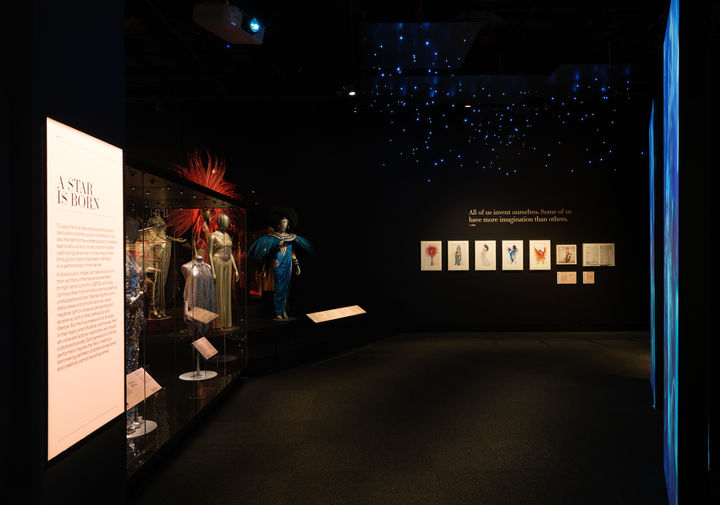
Design concepts featured large built-in display cases to present each theme. To tie the exhibition together and ensure the focus remained on the content, the galleries were painted black and a single feature colour was used to represent each theme.

I developed a flexible label rail system that allowed for these be allocated anywhere across the width of a case. Mounted externally to the case othisapproach meant the labels could be lit separately to the 50 lux internal requirements of the case, and also not compromise space and aesthetic when viewing both the costume and / or text

The allocation and positioning of quotes from the divas'
were part of the approach to the spatial design. This
ensured that the visitor was aware of the voice of these women,their voices heard throughout the exhibition.
Presented in large scale all divas were equal, and the
quote juxtaposed with specific content to layer emotion.


ACT 2. The opulence of costume and performance is centre stage. Sightlines become an important part of the spatial environment, layering the journey and exploiting the drama of the costume. Gloss black plinths with LED lighting framed the mannequins and rose tinted mirror of columns and walls placed the viewer along side the performer. The curtain swags are repeated throughout, to maintain a sense of glamour and lux.
Image on the left (general visitation) by Lesley Fowler




Two typical examples of spatial design documentation during the DevelopedDesign phase.
The elevations code the
exhibition content and text/ label
types.
The 3D sketches aid the development team in visualising the spaces and relationships when assessing graphic and writing requirements and auditing content.
The photographs of the actual installations realised above prove that the 3D sketches here are a good representation of spatial concepts and the design intent

An example of the floor plan I developed to show the spatial arrangement of themes and distribution of AV and scenography throughout the 4 gallery spaces